
Raisu-l-ulama Nedžad ef. Grabus
- Published in
- Category: Raisu-l-ulama
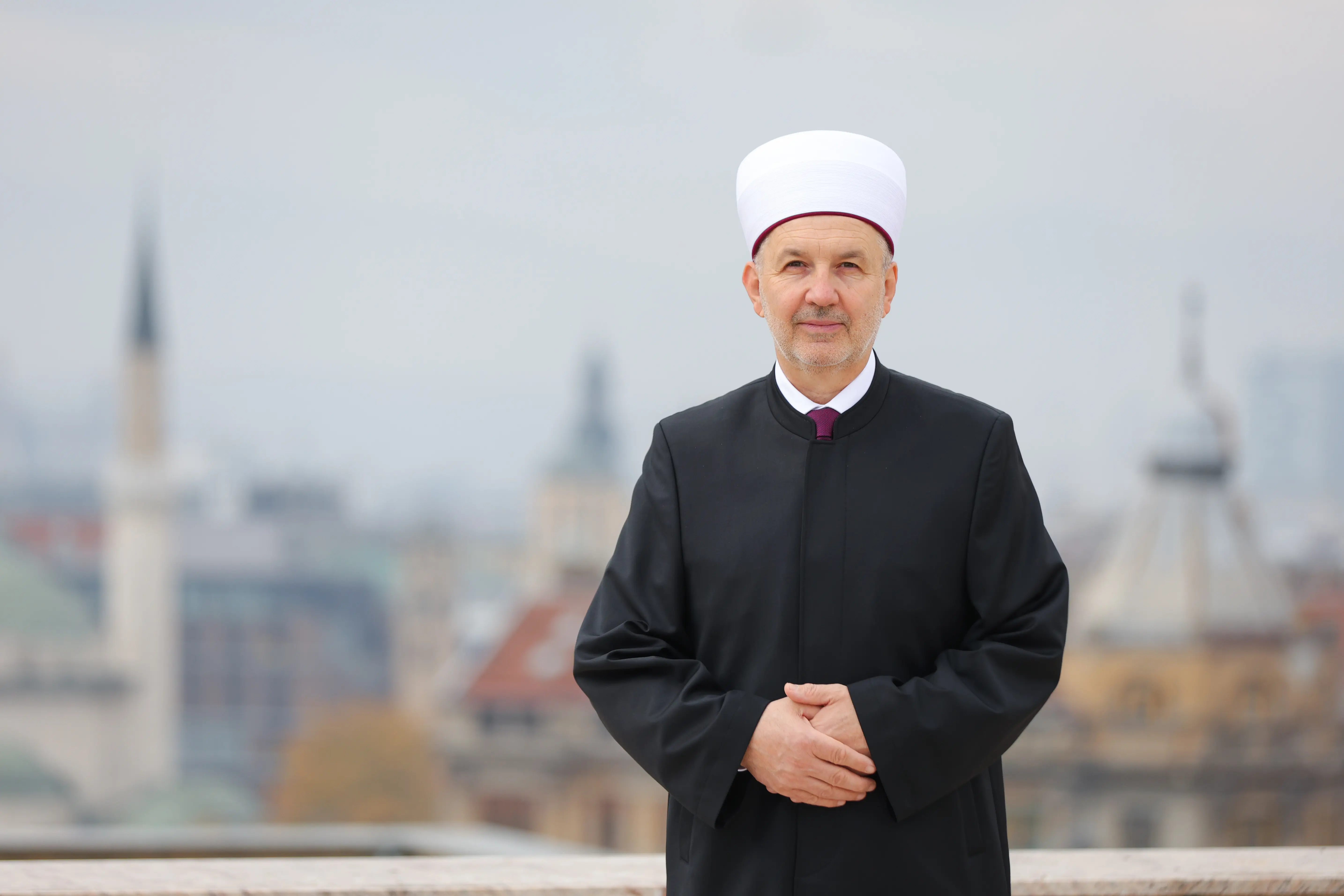
Nedžad Grabus was born in the village of Krpeljići, near Travnik, in 1968.
He graduated from Gazi Husrev-beg Madrasa in 1987 and earned his degree from the Faculty of Islamic Studies in Sarajevo in 1994. He earned a Master’s degree in Aqidah (Islamic Creed) in 2001 and his PhD in 2008. Alongside his postgraduate studies at the Faculty of Islamic Studies in Sarajevo, he completed all the required examinations at the postgraduate studies at the Department of Philosophy, Faculty of Philosophy, University of Sarajevo, between 1995 and 1999.
From November 1994 to March 1996, he worked in the Religious and Educational Department of the Riyasat of the Islamic Community in Bosnia and Herzegovina. From 1996 to 2006, he was employed at the Faculty of Islamic Studies in Sarajevo. He was appointed Full Professor in 2021. His academic field of specialization is Aqidah (Islamic Creed).
He taught at the Faculty of Theology, University of Ljubljana, and served as a visiting lecturer at the Faculty of Law, University of Vienna. He has supervised undergraduate, postgraduate, and doctoral students. He was also a member of committees for master's and doctoral dissertations at the Faculty of Islamic Studies, University of Sarajevo; the Islamic Pedagogical Faculty, University of Bihać; the Faculty of Theology, University of Ljubljana; and the Faculty of Philosophy, University of Zagreb. From 2006 to 2021, he served as the Mufti of Ljubljana and President of the Meshihat of the Islamic Community in Slovenia. From 2021 onwards, he served as the Mufti of Sarajevo. He is a contributor to Preporod, an Islamic news magazine. He has also contributed to the Radio of Bosnia and Herzegovina and Sarajevo Television. He is a member of several editorial boards of academic journals and scholarly organisations in Bosnia and Herzegovina and internationally.
The professional and public engagement of Nedžad Grabus is characterised by his work to strengthen the institutions of the Islamic Community, improve its legal and organisational status, strengthen connections between people and cultures, preserve religious and cultural heritage, and advance scholarship.
Alongside his regular duties within the Islamic Community, his involvement in its institutional development in Bosnia and Herzegovina dates back to 1999, when he took part in a project initiated by the Riyasat of the Islamic Community to establish the Military Mufti’s Office. A few years later, in 2004, as Chair of the Commission of the Assembly of the Islamic Community in Bosnia and Herzegovina, he led the preparation of a feasibility study regarding the need to establish a radio station of the Islamic Community, recognising the importance of communication and media outreach in presenting the values and mission of the Community.
A particularly significant chapter is related to his work in Slovenia, where he devoted many years to the legal, administrative, and institutional development of the Islamic Community. Upon taking up his responsibilities, he found the Community in Slovenia fragmented and divided. Through his dedicated efforts, he succeeded not only in bringing the Community together but also in helping it become one of the most prominent Islamic communities in Europe. The signing of an agreement with the Government of the Republic of Slovenia in 2007, concerning the legal status of the Islamic Community in Slovenia, represented an important step towards regulating its status and establishing more stable conditions for its activities. From 2006 to 2018, he worked continuously to strengthen its institutional foundations, recognising that the lasting and effective functioning of a religious community requires not only dedication to its mission but also a well-established legal framework.
Grabus’s work in Slovenia was characterised by his commitment to intercultural dialogue, education, and the inclusion of minority communities in society. Through the development of numerous projects, he advocated a better understanding of diversity, the advancement of knowledge and skills, as well as equal opportunities for active participation in social life. In recognition of his successful role in achieving unity and strengthening the work of the Islamic Community in Slovenia, the President of the Republic of Slovenia awarded the then Mufti Nedžad Grabus the Silver Order of Merit of the Republic of Slovenia.
The most significant undertaking of his work in Slovenia was the construction of the Islamic Cultural Centre in Ljubljana, a project on which he worked from 2008 to 2020. As the person responsible for the project, he led and supervised all its key stages – from the selection of the site and the purchase of land, through an international architectural competition organised in cooperation between the Islamic Community in Slovenia and the City of Ljubljana, to the completion of construction, the acquisition of the necessary occupancy permits, and the opening of the mosque for use on 7 February 2020. This project represents the culmination of his longstanding institutional engagement and a substantial contribution to the religious, cultural, and social life of Muslims in Slovenia. Alongside the construction and development of institutional infrastructure, he also worked to establish the material foundations for the long-term activities of the Islamic Community in Slovenia through the acquisition of waqf properties across the country. These investments were of lasting importance for the visibility and development of the Islamic Community as well as providing facilities for its religious, educational, and social activities.
Following his appointment as Mufti of Sarajevo, under different circumstances he maintained a focus on people's needs and institutional development. Notable projects during the 2024–2026 period include the acquisition and renovation of the first waqf property owned by the Sarajevo Mufti’s Office, designated to provide accommodation for students, and the initiative to have the Hatma-dua ceremony at Karići included on the List of Intangible Cultural Heritage of Bosnia and Herzegovina, in cooperation with the Federal Ministry of Culture. Although these two projects represent only a part of the numerous initiatives of Nedžad Grabus, they illustrate the fundamental directions of his work. The first is aimed at strengthening the physical and institutional capacities of the Mufti’s Office and the Islamic Community, emphasising the needs of young people and their education, while the second contributes to the preservation and promotion of a spiritual and cultural tradition that forms part of Bosnia and Herzegovina’s heritage.
He represents the Islamic Community in the Interreligious Council of Bosnia and Herzegovina and, in September 2026, assumed the presidency of the Council’s Assembly.
Research and scholarship have an important place in Nedžad Grabus’s work. His academic career has been shaped by many years of research into Aqidah (Islamic Creed) and Islamic theological thought, as well as by his commitment to examining fundamental questions of faith in dialogue with contemporary society, cultural diversity, and the challenges of interreligious understanding. He explored these themes in his books Faith, Knowledge and Cognition (Vjera, znanje i spoznaja), Sheikh Juyo’s Interpretation of Fundamental Themes in Maturidi Aqidah (Šejh-Jujino tumačenje temeljnih tema maturidijskog akaida), and From the “Other” to the Neighbour (Od „drugoga“ do bližnjega), bringing the study of classical Islamic theological tradition into conversation with questions of faith, knowledge, pluralism, and coexistence. His scholarly papers have been published in domestic and international journals, conference proceedings, and academic publications. His book Annotated Legal Documents on Islam in Europe: Slovenia, published by Brill in 2021, and his co-authored book with Professor Dženan Kulović, Food Waste Management: Household, Economic and Religious Perspectives, published by Palgrave Macmillan in 2026, demonstrate the breadth of his research interests and his presence in international academic publishing.
In addition to his work as an author, Grabus has made a significant contribution to the development of scholarly and educational activities through the compilation of academic readers, the editing of collected volumes, participation in the preparation of important publications of the Islamic Community, and involvement in numerous projects. His contributions include the study and presentation of Islamic theological heritage and the creation of opportunities for serious discussion of Islam in contemporary European society. His participation in numerous international academic conferences, along with his editorial and translation work, presents the profile of a scholar who understands academic engagement not merely as research and publication, but also as the sharing of knowledge and insights, improving dialogue, and building connections between intellectual and cultural environments.
He was elected the fourteenth Raisu-l-Ulama of the Islamic Community in Bosnia and Herzegovina on 10 October 2026.
All these projects – research and education, culture, infrastructure, and institutional development – testify to acommitment to strengthening institutions, preserving identity, and promoting the well-being of all believers and citizens. The defining feature of Grabus’s work is his determination to turn ideas into lasting achievements and the needs of the community into concrete projects that will serve generations to come.