
Jusić: Pope Leo XIV’s Visit to Turkey and Lebanon Is Symbolic, and It Is Not Good That the Messages Were Not Heard in Bosnia and Herzegovina
- Published in
- Category: LATEST NEWS
The recent visit of Pope Leo XIV to Turkey and Lebanon passed almost unnoticed in Bosnia and Herzegovina. Apart from agency news reports, there were hardly any serious analyses of the significance of this apostolic journey and the messages conveyed during it.
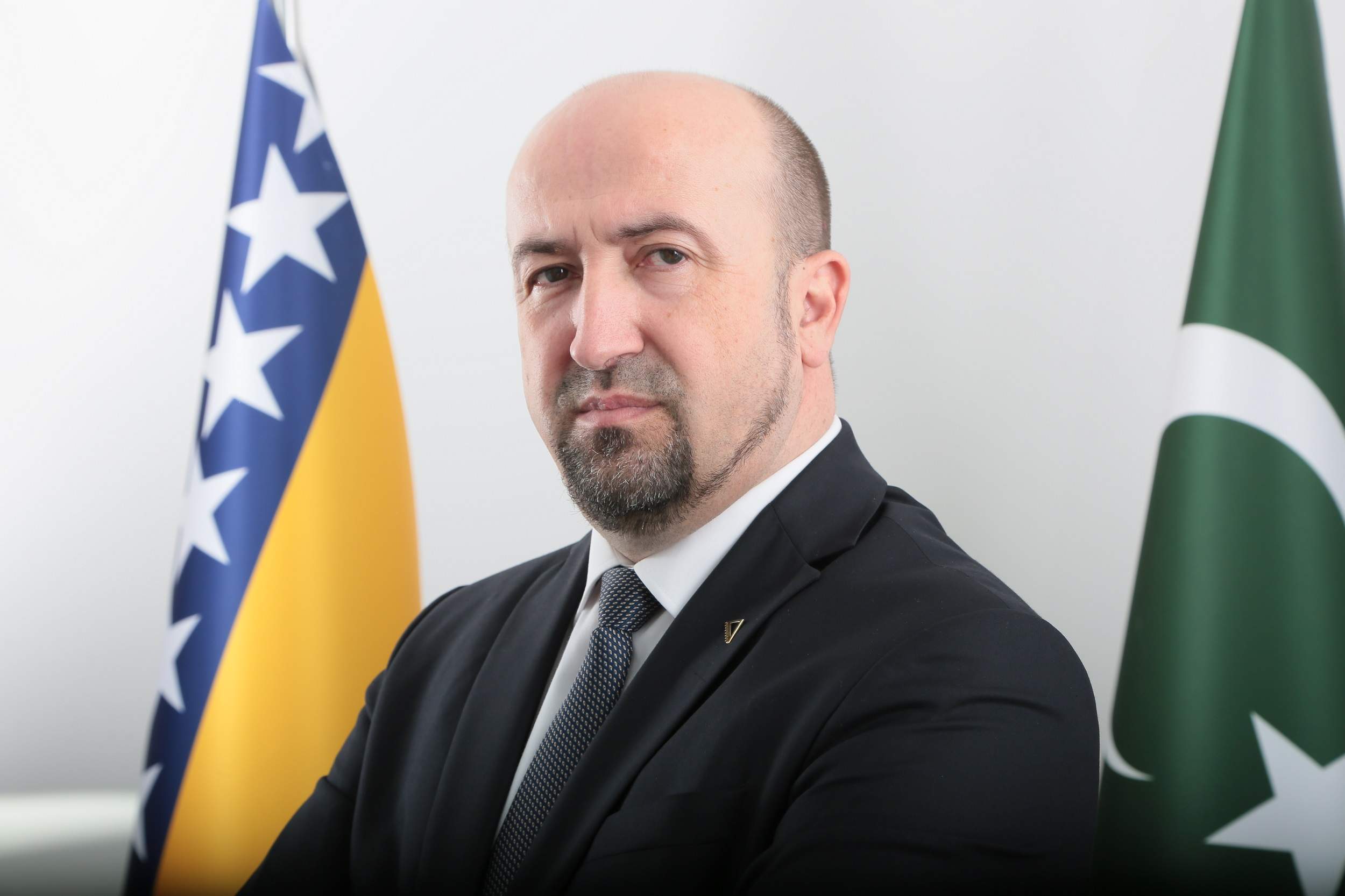
On this occasion, Preporod interviewed Muhamed Jusić, Director of the Department of Foreign Affairs and Diaspora of the Riyasat of the Islamic Community in Bosnia and Herzegovina, a member of the Executive Board of the Interreligious Council in Bosnia and Herzegovina, and former Ambassador of Bosnia and Herzegovina to the Kingdom of Saudi Arabia, Yemen, the Sultanate of Oman, and the Organisation of Islamic Cooperation.
Riyasat member Jusić agreed with Preporod’s observation that this visit did not receive the attention it deserved in the Bosnian public, adding that it is highly significant that Pope Leo XIV chose two predominantly Muslim countries for his first foreign visit.
“The message is extremely symbolic, and it is not good that these messages were not heard in Bosnia and Herzegovina, if we are not to conclude that they may have been deliberately ignored.
The messages about the mutual interdependence of Muslims and Christians and the necessity of mutual respect, which were voiced during the Pope’s apostolic journey, are today perhaps more necessary than in some earlier periods, when the world was not globalised to the extent it is today and when Muslims and Christians did not live together in so many shared, multi-confessional societies as they do now. Messages about the importance of strengthening ties between Eastern and Western Christianity also deserve serious attention. At a time when there are clear efforts by certain circles to ensure that Islam and Christianity are less and less religions, and increasingly markers of culture and political dominance, it is crucial to have a Pope who is aware of these dangers and who equally reminds both Christians and Muslims of the risks of such an attitude toward the sacred and the meaning of faith and life,” Jusić said.
Seeking to Legitimize Exclusivism
Asked about the global context in which this visit took place, Jusić stated that the rhetoric of a “clash of civilizations,” often artificially constructed without grounding in everyday reality, is increasingly being used worldwide to target Muslims, especially in environments where they are minorities or immigrants.
“It is evident that across Europe and America an image is spreading that Christianity is under threat from an ‘Islamic danger’ and that mobilisation is necessary to defend the Christian world. This polarises and destabilises societies, leading to a general sense of insecurity, uncertainty, and mistrust. In this process, there is no hesitation in resorting to dehumanisation, violations of basic human rights, and the spread of hatred toward Muslims, developments that increasingly resemble the period preceding the rise of fascism.
For the success of these intolerant and exclusionary ideologies, the support of the Church, especially the Catholic Church as the largest in the world, would be decisive. A Church blessing for such rhetoric and for policies that claim to defend Christian values would amount to their legitimisation. That is why all eyes are on the Pope and his stance toward such interpretations of Christianity and social reality. Among other things, through this visit and the messages conveyed during it, Pope Leo XIV sent a clear message to the proponents of such ideas and policies who seek to instrumentalise religion for political goals,” Jusić explained.
Muslims and Christians Share More Values Than Differences
At the same time, Jusić pointed out that what is happening in the West has its counterparts in the East, and that the world functions according to the principle of interconnected vessels, with reciprocal radicalisation and de-radicalisation.
“The Muslim world has for some time been following a path that some Western societies are now embarking upon. Its own weaknesses were always blamed on others. In public discourse, it has become normal to blame the ‘colonial’ West, often equated with Christianity, for all problems. The fact that the empires which exported conflicts into predominantly Muslim regions and plundered their resources had long ceased to be Christian in their homelands had no effect on radical groups and ideologies ceasing to spread hatred toward minorities and undermine their own societies from within. This has led to a situation in which Christian communities throughout the Muslim world have become targets of radical groups and policies,” Jusić noted.
He reminded that some of these persecuted and discriminated Christian communities belong to denominations that survived only within multi-confessional Muslim societies.
“Even this was not enough for radical elements to stop seeing them as agents of a global conspiracy against Muslims, rather than as their neighbours and friends, often members of the same people with whom they have lived for centuries.
That is why the messages voiced by Pope Leo XIV, as well as by his Muslim hosts, are so significant, messages emphasising the need to preserve traditional Christian communities throughout the Muslim world, to guarantee their freedoms and rights, and to reaffirm the determination of Muslim and Christian believers worldwide to continue their shared historical journey.
Muslims and Christians, as genuine believers and as institutions representing them in today’s world, share more common values and challenges than differences and conflicts. This should serve as an incentive to open new horizons of cooperation, rather than to deepen divisions,” Jusić said.
We Have a Pope Who Understands the Traps
Jusić further believes that the coming century will, among other things, be shaped by the relationship of the Pope and the Catholic Church toward the phenomenon of militant and nationalist religiosity.
“The desire to protect one’s own identity, religious or national, must not become a justification for hatred and intolerance toward the Other. Neither in the East nor in the West is it a good path to mobilise collective identity by spreading distrust toward others and inventing enemies.
It is therefore encouraging that, after Pope Francis, we once again have a Pope who understands the traps of promoting the concept of a clash of civilizations. This indicates that the Catholic Church, in its mainstream, is aware of the dangers of creating new global conflicts along religious, cultural, and civilisational fault lines, and that it will continue to seek partners around the world, including among Muslims, who recognise the same challenges and are willing to stop new fascisms, genocides, holocausts, pogroms, and holy wars while there is still time.
That is why we can rightly say that we are encouraged by the Pope’s first foreign visit,” Jusić concluded.
It should be recalled that nearly seven months after his election as a Pope, Leo XIV embarked on his first international trip.
From 27 to 30 November, he visited the Republic of Turkey, followed by a visit to Lebanon until 2 December. In doing so, the head of the Catholic Church, originally from the United States of America, continued the international engagement of his predecessors and, it seems, the open policy of dialogue with Muslims pursued by Pope Francis.
(IIN Preporod)